what features developed among groups of fish that eventually gave rise to tetrapods?

The evolution of tetrapods began about 400 million years ago in the Devonian Period with the earliest tetrapods evolved from lobe-finned fishes.[1] Tetrapods (under the apomorphy-based definition used on this page) are categorized every bit animals in the biological superclass Tetrapoda, which includes all living and extinct amphibians, reptiles, birds, and mammals. While most species today are terrestrial, little testify supports the idea that whatsoever of the earliest tetrapods could motion nigh on land, equally their limbs could not take held their midsections off the ground and the known trackways practice non signal they dragged their bellies around. Presumably, the tracks were made by animals walking along the bottoms of shallow bodies of water.[2] The specific aquatic ancestors of the tetrapods, and the process past which country colonization occurred, remain unclear. They are areas of active research and debate among palaeontologists at present.
Nearly amphibians today remain semiaquatic, living the commencement phase of their lives every bit fish-like tadpoles. Several groups of tetrapods, such as the snakes and cetaceans, take lost some or all of their limbs. In addition, many tetrapods have returned to partially aquatic or fully aquatic lives throughout the history of the group (mod examples of fully aquatic tetrapods include cetaceans and sirenians). The kickoff returns to an aquatic lifestyle may have occurred as early on as the Carboniferous Menstruum[3] whereas other returns occurred equally recently equally the Cenozoic, as in cetaceans, pinnipeds,[4] and several modern amphibians.[5]
The modify from a body plan for breathing and navigating in water to a body programme enabling the brute to move on state is i of the most profound evolutionary changes known.[6] It is also one of the all-time understood, largely thanks to a number of meaning transitional fossil finds in the late 20th century combined with improved phylogenetic assay.[1]
Origin [edit]
Development of fish [edit]
The Devonian menses is traditionally known as the "Age of Fish", marking the diversification of numerous extinct and modern major fish groups.[7] Among them were the early bony fishes, who diversified and spread in freshwater and stagnant environments at the beginning of the period. The early on types resembled their cartilaginous ancestors in many features of their beefcake, including a shark-like tailfin, spiral gut, large pectoral fins stiffened in front by skeletal elements and a largely unossified axial skeleton.[8]
They did, however, have certain traits separating them from cartilaginous fishes, traits that would get pivotal in the evolution of terrestrial forms. With the exception of a pair of spiracles, the gills did not open up singly to the outside as they practice in sharks; rather, they were encased in a gill chamber stiffened by membrane bones and covered by a bony operculum, with a single opening to the exterior. The cleithrum os, forming the posterior margin of the gill sleeping accommodation, too functioned as anchoring for the pectoral fins. The cartilaginous fishes do not accept such an anchoring for the pectoral fins. This immune for a movable joint at the base of the fins in the early bony fishes, and would later office in a weight bearing structure in tetrapods. Every bit role of the overall armour of rhomboid cosmin scales, the skull had a full embrace of dermal os, constituting a skull roof over the otherwise shark-like cartilaginous inner attic. Importantly, they also had a pair of ventral paired lungs,[nine] a feature lacking in sharks and rays.
Information technology was assumed that fishes to a big degree evolved effectually reefs, but since their origin about 480 meg years agone, they lived in nearly-shore environments like intertidal areas or permanently shallow lagoons and didn't offset to proliferate into other biotopes before lx one thousand thousand years later. A few adjusted to deeper h2o, while solid and heavily built forms stayed where they were or migrated into freshwater.[10] [11] The increase of primary productivity on country during the late Devonian changed the freshwater ecosystems. When nutrients from plants were released into lakes and rivers, they were captivated past microorganisms which in turn was eaten by invertebrates, which served as food for vertebrates. Some fish also became detritivores.[12] Early tetrapods evolved a tolerance to environments which varied in salinity, such as estuaries or deltas.[13]
Lungs before land [edit]
The lung/swim bladder originated every bit an outgrowth of the gut, forming a gas-filled float above the digestive system. In its primitive course, the air bladder was open to the alimentary canal, a condition called physostome and even so plant in many fish.[14] The principal function is not entirely sure. I consideration is buoyancy. The heavy calibration armour of the early bony fishes would certainly weigh the animals downward. In cartilaginous fishes, lacking a swim bladder, the open up sea sharks demand to swim constantly to avoid sinking into the depths, the pectoral fins providing lift.[xv] Another factor is oxygen consumption. Ambience oxygen was relatively low in the early Devonian, possibly near half of modern values.[16] Per unit volume, there is much more than oxygen in air than in water, and vertebrates are agile animals with a high energy requirement compared to invertebrates of similar sizes.[17] [xviii] The Devonian saw increasing oxygen levels which opened up new ecological niches past allowing groups able to exploit the additional oxygen to develop into active, large-bodied animals.[16] Specially in tropical swampland habitats, atmospheric oxygen is much more stable, and may have prompted a reliance of lungs rather than gills for primary oxygen uptake.[xix] [twenty] In the finish, both buoyancy and breathing may have been of import, and some modern physostome fishes do indeed use their bladders for both.
To function in gas exchange, lungs crave a claret supply. In cartilaginous fishes and teleosts, the eye lies depression in the body and pumps claret frontward through the ventral aorta, which splits up in a series of paired aortic arches, each corresponding to a gill arch.[21] The aortic arches then merge in a higher place the gills to form a dorsal aorta supplying the body with oxygenated blood. In lungfishes, bowfin and bichirs, the swim bladder is supplied with blood by paired pulmonary arteries branching off from the hindmost (sixth) aortic curvation.[22] The same bones pattern is found in the lungfish Protopterus and in terrestrial salamanders, and was probably the blueprint found in the tetrapods' immediate ancestors as well as the beginning tetrapods.[23] In most other bony fishes the swim bladder is supplied with blood by the dorsal aorta.[22]
The jiff [edit]
In order for the lungs to allow gas substitution, the lungs first need to have gas in them. In modern tetrapods, three important breathing mechanisms are conserved from early ancestors, the first existence a CO2/H+ detection organization. In mod tetrapod breathing, the impulse to take a breath is triggered by a buildup of CO2 in the bloodstream and not a lack of O2.[24] A like COii/H+ detection organization is found in all Osteichthyes, which implies that the last mutual ancestor of all Osteichthyes had a demand of this sort of detection organisation.[24] [25] The 2d mechanism for a jiff is a surfactant organisation in the lungs to facilitate gas exchange. This is also found in all Osteichthyes, fifty-fifty those that are well-nigh entirely aquatic.[26] [27] The highly conserved nature of this system suggests that even aquatic Osteichthyes accept some need for a surfactant organization, which may seem strange as there is no gas underwater. The third mechanism for a breath is the actual motion of the breath. This mechanism predates the terminal common ancestor of Osteichthyes, as information technology can be observed in Lampetra camtshatica, the sister clade to Osteichthyes. In Lampreys, this machinery takes the form of a "cough", where the lamprey shakes its body to allow h2o period across its gills. When COii levels in the lamprey's blood climb besides high, a signal is sent to a central pattern generator that causes the lamprey to "cough" and allow COii to leave its trunk.[28] [29] This linkage between the CO2 detection system and the central pattern generator is extremely similar to the linkage between these two systems in tetrapods, which implies homology.
External and internal nares [edit]
The nostrils in virtually bony fish differ from those of tetrapods. Commonly, bony fish have four nares (nasal openings), one naris behind the other on each side. Every bit the fish swims, water flows into the forward pair, across the olfactory tissue, and out through the posterior openings. This is truthful not only of ray-finned fish simply likewise of the coelacanth, a fish included in the Sarcopterygii, the grouping that as well includes the tetrapods. In dissimilarity, the tetrapods accept merely one pair of nares externally but also sport a pair of internal nares, called choanae, assuasive them to draw air through the nose. Lungfish are as well sarcopterygians with internal nostrils, but these are sufficiently different from tetrapod choanae that they accept long been recognized as an independent evolution.[30]
The evolution of the tetrapods' internal nares was hotly debated in the 20th century. The internal nares could be one set of the external ones (commonly presumed to be the posterior pair) that have migrated into the mouth, or the internal pair could be a newly evolved structure. To brand mode for a migration, however, the 2 tooth-bearing basic of the upper jaw, the maxilla and the premaxilla, would have to divide to let the nostril through and then rejoin; until recently, there was no bear witness for a transitional stage, with the 2 bones asunder. Such testify is at present available: a small lobe-finned fish called Kenichthys, found in China and dated at effectually 395 million years former, represents evolution "caught in mid-act", with the maxilla and premaxilla separated and an aperture—the incipient choana—on the lip in between the 2 basic.[31] Kenichthys is more closely related to tetrapods than is the coelacanth,[32] which has only external nares; it thus represents an intermediate stage in the development of the tetrapod status. The reason for the evolutionary movement of the posterior nostril from the olfactory organ to lip, however, is not well understood.
Into the shallows [edit]
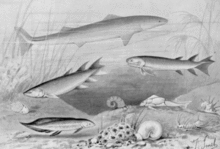
The relatives of Kenichthys presently established themselves in the waterways and brackish estuaries and became the near numerous of the bony fishes throughout the Devonian and virtually of the Carboniferous. The basic anatomy of group is well known thank you to the very detailed work on Eusthenopteron by Erik Jarvik in the second half of the 20th century.[33] The bones of the skull roof were broadly similar to those of early tetrapods and the teeth had an infolding of the enamel similar to that of labyrinthodonts. The paired fins had a build with bones distinctly homologous to the humerus, ulna, and radius in the fore-fins and to the femur, tibia, and fibula in the pelvic fins.[34]
There were a number of families: Rhizodontida, Canowindridae, Elpistostegidae, Megalichthyidae, Osteolepidae and Tristichopteridae.[35] About were open-water fishes, and some grew to very big sizes; adult specimens are several meters in length.[36] The Rhizodontid Rhizodus is estimated to have grown to seven meters (23 feet), making it the largest freshwater fish known.[37]
While about of these were open-water fishes, ane group, the Elpistostegalians, adjusted to life in the shallows. They evolved flat bodies for movement in very shallow h2o, and the pectoral and pelvic fins took over as the principal propulsion organs. Most median fins disappeared, leaving only a protocercal tailfin. Since the shallows were subject to occasional oxygen deficiency, the power to breathe atmospheric air with the swim bladder became increasingly important.[half dozen] The spiracle became large and prominent, enabling these fishes to describe air.
Skull morphology [edit]
The tetrapods have their root in the early Devonian tetrapodomorph fish.[38] Primitive tetrapods adult from an osteolepid tetrapodomorph lobe-finned fish (sarcopterygian-crossopterygian), with a two-lobed brain in a flattened skull. The coelacanth group represents marine sarcopterygians that never acquired these shallow-water adaptations. The sarcopterygians plain took two dissimilar lines of descent and are accordingly separated into two major groups: the Actinistia (including the coelacanths) and the Rhipidistia (which include extinct lines of lobe-finned fishes that evolved into the lungfish and the tetrapodomorphs).
From fins to feet [edit]
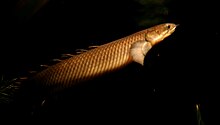
Stalked fins like those of the bichirs can be used for terrestrial movement
The oldest known tetrapodomorph is Kenichthys from China, dated at around 395 million years quondam. Two of the primeval tetrapodomorphs, dating from 380 Ma, were Gogonasus and Panderichthys.[39] They had choanae and used their fins to move through tidal channels and shallow waters choked with dead branches and rotting plants.[xl] Their fins could have been used to attach themselves to plants or like while they were lying in ambush for prey. The universal tetrapod characteristics of front limbs that curve forwards from the elbow and hind limbs that bend backward from the knee tin plausibly be traced to early tetrapods living in shallow h2o. Pelvic os fossils from Tiktaalik shows, if representative for early tetrapods in general, that hind appendages and pelvic-propelled locomotion originated in h2o before terrestrial adaptations.[41]
Some other indication that feet and other tetrapod traits evolved while the animals were nevertheless aquatic is how they were feeding. They did not have the modifications of the skull and jaw that allowed them to swallow prey on land. Prey could be defenseless in the shallows, at the water's edge or on state, but had to exist eaten in h2o where hydrodynamic forces from the expansion of their buccal cavity would force the nutrient into their esophagus.[42]
It has been suggested that the evolution of the tetrapod limb from fins in lobe-finned fishes is related to expression of the HOXD13 gene or the loss of the proteins actinodin 1 and actinodin two, which are involved in fish fin development.[43] [44] Robot simulations suggest that the necessary nervous circuitry for walking evolved from the fretfulness governing swimming, utilizing the sideways oscillation of the body with the limbs primarily performance as anchoring points and providing express thrust.[45] This blazon of motion, equally well as changes to the pectoral girdle are like to those seen in the fossil record can be induced in bichirs past raising them out of water.[46]
A 2012 study using 3D reconstructions of Ichthyostega concluded that it was incapable of typical quadrupedal gaits. The limbs could not move alternately as they lacked the necessary rotary motion range. In addition, the hind limbs lacked the necessary pelvic musculature for hindlimb-driven land motion. Their nearly probable method of terrestrial locomotion is that of synchronous "crutching motions", like to modern mudskippers.[47] (Viewing several videos of mudskipper "walking" shows that they motion by pulling themselves forward with both pectoral fins at the same time (left & right pectoral fins motion simultaneously, non alternatively). The fins are brought frontwards and planted; the shoulders then rotate rearward, advancing the trunk & dragging the tail as a third signal of contact. There are no rear "limbs"/fins, and there is no significant flexure of the spine involved.)
Denizens of the swamp [edit]
The first tetrapods probably evolved in coastal and brackish marine environments, and in shallow and swampy freshwater habitats.[48] Formerly, researchers thought the timing was towards the end of the Devonian. In 2010, this conventionalities was challenged by the discovery of the oldest known tetrapod tracks, preserved in marine sediments of the southern coast of Laurasia, now Świętokrzyskie (Holy Cantankerous) Mountains of Poland. They were made during the Eifelian stage at the end of the Centre Devonian. The tracks, some of which bear witness digits, date to about 395 million years ago—18 meg years earlier than the oldest known tetrapod body fossils.[49] Additionally, the tracks show that the animal was capable of thrusting its arms and legs forrad, a type of move that would accept been incommunicable in tetrapodomorph fish similar Tiktaalik. The animal that produced the tracks is estimated to have been upwards to ii.five metres (8.2 ft) long with footpads upwardly to 26 centimetres (10 in) wide, although most tracks are merely fifteen centimetres (5.9 in) broad.[50]
The new finds suggest that the start tetrapods may have lived every bit opportunists on the tidal flats, feeding on marine animals that were washed up or stranded by the tide.[49] Currently, however, fish are stranded in meaning numbers just at certain times of yr, equally in alewife spawning flavor; such strandings could not provide a significant supply of nutrient for predators. At that place is no reason to suppose that Devonian fish were less prudent than those of today.[51] Co-ordinate to Melina Hale of University of Chicago, not all aboriginal trackways are necessarily fabricated by early tetrapods, but could as well be created by relatives of the tetrapods who used their fleshy appendages in a similar substrate-based locomotion.[52] [53]
Palaeozoic tetrapods [edit]
Devonian tetrapods [edit]
Enquiry by Jennifer A. Clack and her colleagues showed that the very primeval tetrapods, animals similar to Acanthostega, were wholly aquatic and quite unsuited to life on land. This is in dissimilarity to the earlier view that fish had commencement invaded the land — either in search of casualty (like modern mudskippers) or to detect water when the pond they lived in stale out — and later evolved legs, lungs, etc.
Past the late Devonian, land plants had stabilized freshwater habitats, allowing the beginning wetland ecosystems to develop, with increasingly complex food webs that afforded new opportunities. Freshwater habitats were not the merely places to detect water filled with organic matter and dumbo vegetation well-nigh the water's edge. Swampy habitats similar shallow wetlands, coastal lagoons and large brackish river deltas too existed at this time, and there is much to suggest that this is the kind of environment in which the tetrapods evolved. Early fossil tetrapods take been found in marine sediments, and because fossils of primitive tetrapods in full general are found scattered all around the globe, they must have spread by post-obit the coastal lines — they could not have lived in freshwater only.
One analysis from the University of Oregon suggests no evidence for the "shrinking waterhole" theory - transitional fossils are not associated with prove of shrinking puddles or ponds - and indicates that such animals would probably not have survived short treks between depleted waterholes.[54] The new theory suggests instead that proto-lungs and proto-limbs were useful adaptations to negotiate the surroundings in boiling, wooded floodplains.[55]
The Devonian tetrapods went through two major bottlenecks during what is known equally the Late Devonian extinction; ane at the end of the Frasnian stage, and i twice as large at the stop of the post-obit Famennian phase. These events of extinctions led to the disappearance of archaic tetrapods with fish-similar features like Ichthyostega and their master more aquatic relatives.[56] When tetrapods reappear in the fossil record after the Devonian extinctions, the adult forms are all fully adapted to a terrestrial being, with later species secondarily adapted to an aquatic lifestyle.[57]
Lungs [edit]
Information technology is now clear that the common ancestor of the bony fishes (Osteichthyes) had a primitive air-breathing lung—later on evolved into a swim float in most actinopterygians (ray-finned fishes). This suggests that crossopterygians evolved in warm shallow waters, using their simple lung when the oxygen level in the water became too low.
Fleshy lobe-fins supported on bones rather than ray-stiffened fins seem to take been an bequeathed trait of all bony fishes (Osteichthyes). The lobe-finned ancestors of the tetrapods evolved them further, while the ancestors of the ray-finned fishes (Actinopterygii) evolved their fins in a dissimilar direction. The most primitive group of actinopterygians, the bichirs, still have fleshy frontal fins.
Fossils of early tetrapods [edit]
Nine genera of Devonian tetrapods have been described, several known mainly or entirely from lower jaw material. All simply one were from the Laurasian supercontinent, which comprised Europe, North America and Greenland. The only exception is a single Gondwanan genus, Metaxygnathus, which has been establish in Commonwealth of australia.
The showtime Devonian tetrapod identified from Asia was recognized from a fossil jawbone reported in 2002. The Chinese tetrapod Sinostega pani was discovered among fossilized tropical plants and lobe-finned fish in the scarlet sandstone sediments of the Ningxia Hui Autonomous Region of northwest China. This finding substantially extended the geographical range of these animals and has raised new questions about the worldwide distribution and bang-up taxonomic diversity they achieved within a relatively short fourth dimension.
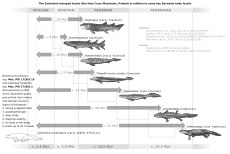
Oldest tetrapod tracks from Zachelmie in relation to key Devonian tetrapodomorph body fossils
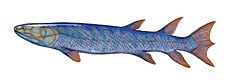
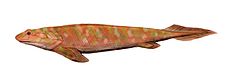
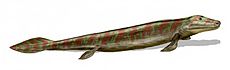
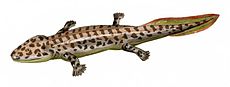
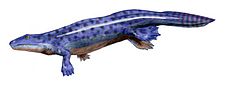
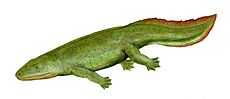
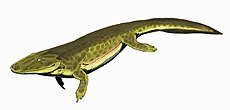
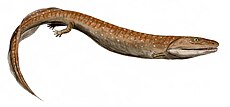
These earliest tetrapods were not terrestrial. The earliest confirmed terrestrial forms are known from the early Carboniferous deposits, some 20 million years later. Nevertheless, they may have spent very brief periods out of water and would accept used their legs to manus their manner through the mud.
Why they went to state in the first place is all the same debated. One reason could exist that the small juveniles who had completed their metamorphosis had what it took to brand use of what land had to offer. Already adapted to breathe air and motility around in shallow waters almost land as a protection (just every bit modern fish and amphibians ofttimes spend the kickoff part of their life in the comparative safety of shallow waters like mangrove forests), two very different niches partially overlapped each other, with the young juveniles in the diffuse line between. One of them was overcrowded and dangerous while the other was much safer and much less crowded, offer less competition over resource. The terrestrial niche was also a much more challenging place for primarily aquatic animals, but because of the fashion evolution and pick force per unit area work, those juveniles who could have advantage of this would be rewarded. Once they gained a small foothold on land, thanks to their pre-adaptations, favourable variations in their descendants would gradually consequence in continuing evolution and diversification.
At this fourth dimension the abundance of invertebrates crawling around on land and near h2o, in moist soil and moisture litter, offered a food supply. Some were even big enough to eat small-scale tetrapods, but the country was complimentary from dangers common in the h2o.
From h2o to land [edit]
Initially making only tentative forays onto country, tetrapods adjusted to terrestrial environments over time and spent longer periods away from the water. It is also possible that the adults started to spend some fourth dimension on land (as the skeletal modifications in early tetrapods such as Ichthyostega suggests) to relish in the sun shut to the water's edge[ citation needed ], while otherwise being mostly aquatic.
Carboniferous tetrapods [edit]
Until the 1990s, there was a 30 1000000 year gap in the fossil record between the belatedly Devonian tetrapods and the reappearance of tetrapod fossils in recognizable mid-Carboniferous amphibian lineages. Information technology was referred to every bit "Romer's Gap", which at present covers the menses from about 360 to 345 one thousand thousand years agone (the Devonian-Carboniferous transition and the early Mississippian), afterward the palaeontologist who recognized it.
During the "gap", tetrapod backbones developed, as did limbs with digits and other adaptations for terrestrial life. Ears, skulls and vertebral columns all underwent changes too. The number of digits on hands and feet became standardized at five, every bit lineages with more digits died out. Thus, those very few tetrapod fossils constitute in this "gap" are all the more prized by palaeontologists because they document these meaning changes and clarify their history.
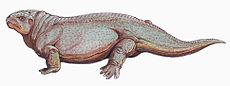
The transition from an aquatic, lobe-finned fish to an air-breathing amphibian was a significant and fundamental one in the evolutionary history of the vertebrates. For an organism to live in a gravity-neutral aqueous environs, so colonize one that requires an organism to support its entire weight and possess a mechanism to mitigate dehydration, required pregnant adaptations or exaptations within the overall torso plan, both in form and in function. Eryops, an example of an brute that made such adaptations, refined many of the traits found in its fish ancestors. Sturdy limbs supported and transported its body while out of h2o. A thicker, stronger backbone prevented its trunk from sagging nether its own weight. Also, through the reshaping of vestigial fish jaw bones, a rudimentary center ear began developing to connect to the piscine inner ear, assuasive Eryops to amplify, and so better sense, airborne sound.
By the Visean (mid early on-Carboniferous) stage, the early on tetrapods had radiated into at least three or four master branches. Some of these unlike branches stand for the ancestors to all living tetrapods. This means that the common antecedent of all living tetrapods likely lived in the early Carboniferous. Under a narrow cladistic definition of Tetrapoda (also known as crown-Tetrapoda), which only includes descendants of this common ancestor, tetrapods first appeared in the Carboniferous. Recognizable early on tetrapods (in the broad sense) are representative of the temnospondyls (east.g. Eryops) lepospondyls (e.g. Diplocaulus), anthracosaurs, which were the relatives and ancestors of the Amniota, and possibly the baphetids, which are thought to be related to temnospondyls and whose condition as a principal branch is yet unresolved. Depending on which regime 1 follows, mod amphibians (frogs, salamanders and caecilians) are most probably derived from either temnospondyls or lepospondyls (or maybe both, although this is now a minority position).
The first amniotes (clade of vertebrates that today includes reptiles, mammals, and birds) are known from the early office of the Tardily Carboniferous. By the Triassic, this group had already radiated into the earliest mammals, turtles, and crocodiles (lizards and birds appeared in the Jurassic, and snakes in the Cretaceous). This contrasts sharply with the (possibly 4th) Carboniferous grouping, the baphetids, which have left no extant surviving lineages.
Carboniferous rainforest collapse [edit]
Amphibians and reptiles were strongly afflicted by the Carboniferous rainforest collapse (CRC), an extinction event that occurred ~307 million years agone. The Carboniferous menstruum has long been associated with thick, steamy swamps and humid rainforests.[58] Since plants course the base of operations of almost all of Earth'south ecosystems, any changes in found distribution have e'er affected animal life to some degree. The sudden collapse of the vital rainforest ecosystem profoundly affected the diversity and abundance of the major tetrapod groups that relied on information technology.[59] The CRC, which was a office of one of the top two near devastating institute extinctions in Earth's history, was a self-reinforcing and very rapid modify of environment wherein the worldwide climate became much drier and libation overall (although much new work is being done to meliorate empathize the fine-grained historical climate changes in the Carboniferous-Permian transition and how they arose[60]).
The ensuing worldwide plant reduction resulting from the difficulties plants encountered in adjusting to the new climate caused a progressive fragmentation and collapse of rainforest ecosystems. This reinforced so farther accelerated the collapse by sharply reducing the amount of animal life which could be supported by the shrinking ecosystems at that time. The consequence of this beast reduction was a crash in global carbon dioxide levels, which impacted the plants even more than.[61] The dehydration and temperature drib which resulted from this runaway constitute reduction and decrease in a primary greenhouse gas caused the Earth to apace enter a series of intense Ice Ages.[58]
This impacted amphibians in particular in a number of ways. The enormous drib in sea level due to greater quantities of the earth's h2o beingness locked into glaciers profoundly affected the distribution and size of the semiaquatic ecosystems which amphibians favored, and the meaning cooling of the climate farther narrowed the amount of new territory favorable to amphibians. Given that amongst the hallmarks of amphibians are an obligatory return to a bounding main to lay eggs, a delicate skin prone to desiccation (thereby often requiring the amphibian to be relatively shut to water throughout its life), and a reputation of being a bellwether species for disrupted ecosystems due to the resulting low resilience to ecological modify,[62] amphibians were particularly devastated, with the Labyrinthodonts among the groups faring worst. In contrast, reptiles - whose amniotic eggs have a membrane that enables gas commutation out of water, and which thereby can be laid on land - were better adjusted to the new conditions. Reptiles invaded new niches at a faster rate and began diversifying their diets, becoming herbivorous and carnivorous, rather than feeding exclusively on insects and fish.[63] Meanwhile, the severely impacted amphibians simply could non out-compete reptiles in mastering the new ecological niches,[64] and then were obligated to pass the tetrapod evolutionary torch to the increasingly successful and swiftly radiating reptiles.
Permian tetrapods [edit]
In the Permian period: early "amphibia" (labyrinthodonts) clades included temnospondyl and anthracosaur; while amniote clades included the Sauropsida and the Synapsida. Sauropsida would eventually evolve into today's reptiles and birds; whereas Synapsida would evolve into today'due south mammals. During the Permian, however, the distinction was less clear—amniote fauna existence typically described as either reptile or as mammal-like reptile. The latter (synapsida) were the most important and successful Permian animals.
The end of the Permian saw a major turnover in fauna during the Permian–Triassic extinction event: probably the virtually severe mass extinction outcome of the phanerozoic. There was a protracted loss of species, due to multiple extinction pulses.[65] Many of the one time large and diverse groups died out or were greatly reduced.
Mesozoic tetrapods [edit]
Life on World seemed to recover apace afterward the Permian extinctions, though this was mostly in the course of disaster taxa such as the hardy Lystrosaurus. Specialized animals that formed complex ecosystems with loftier biodiversity, complex food webs, and a variety of niches, took much longer to recover.[65] Current research indicates that this long recovery was due to successive waves of extinction, which inhibited recovery, and to prolonged environmental stress to organisms that connected into the Early Triassic. Recent enquiry indicates that recovery did non begin until the start of the mid-Triassic, 4M to 6M years afterwards the extinction;[66] and some writers approximate that the recovery was non complete until 30M years after the P-Tr extinction, i.due east. in the tardily Triassic.[65]
A pocket-size group of reptiles, the diapsids, began to diversify during the Triassic, notably the dinosaurs. By the late Mesozoic, the large labyrinthodont groups that starting time appeared during the Paleozoic such as temnospondyls and reptile-like amphibians had gone extinct. All current major groups of sauropsids evolved during the Mesozoic, with birds first appearing in the Jurassic as a derived clade of theropod dinosaurs. Many groups of synapsids such as anomodonts and therocephalians that once comprised the dominant terrestrial fauna of the Permian besides became extinct during the Mesozoic; during the Triassic, nonetheless, one group (Cynodontia) gave rise to the descendant taxon Mammalia, which survived through the Mesozoic to later diversify during the Cenozoic.
Cenozoic tetrapods [edit]
The Cenozoic era began with the end of the Mesozoic era and the Cretaceous epoch; and continues to this 24-hour interval. The beginning of the Cenozoic was marked by the Cretaceous-Paleogene extinction event during which all not-avian dinosaurs became extinct. The Cenozoic is sometimes chosen the "Historic period of Mammals".
During the Mesozoic, the prototypical mammal was a modest nocturnal insectivore something like a tree shrew. Due to their nocturnal habits, most mammals lost their color vision, and greatly improved their sense of olfaction and hearing. All mammals of today are shaped past this origin. Primates and some Australian marsupials later re-evolved color-vision.
During the Paleocene and Eocene, most mammals remained small (under 20 kg). Cooling climate in the Oligocene and Miocene, and the expansion of grasslands favored the development of larger mammalian species.
Ratites run, and penguins swim and waddle: but the majority of birds are rather small, and can fly. Some birds use their ability to wing to consummate epic globe-crossing migrations, while others such as frigate birds wing over the oceans for months on end.
Bats have also taken flight, and along with cetaceans have developed echolocation or sonar.
Whales, seals, manatees, and sea otters have returned to the bounding main and an aquatic lifestyle.
Vast herds of ruminant ungulates populate the grasslands and forests. Carnivores have evolved to keep the herd-brute populations in bank check.
Extant (living) tetrapods [edit]
Following the bully faunal turnover at the stop of the Mesozoic, only seven groups of tetrapods were left, with one, the Choristodera, condign extinct 11 Ma due to unknown reasons. The other 6 persisting today also include many extinct members:
- Lissamphibia: frogs and toads, salamanders, and caecilians
- Testudines: turtle, tortoises and terrapins
- Lepidosauria: tuataras, lizards, amphisbaenians and snakes
- Crocodilia: crocodiles, alligators, caimans and gharials
- Neornithes: extant birds
- Mammalia: mammals
References [edit]
- ^ a b Shubin, N. (2008). Your Inner Fish: A Journey Into the three.five-Billion-Year History of the Human Trunk. New York: Pantheon Books. ISBN978-0-375-42447-two.
- ^ Clack, Jennifer A. (1997). "Devonian tetrapod trackways and trackmakers; a review of the fossils and footprints". Palaeogeography, Palaeoclimatology, Palaeoecology. 130 (i–iv): 227–250. Bibcode:1997PPP...130..227C. doi:ten.1016/S0031-0182(96)00142-3.
- ^ Laurin, M. (2010). How Vertebrates Left the H2o. Berkeley, California, United states of america.: University of California Printing. ISBN978-0-520-26647-6.
- ^ Canoville, Aurore; Laurin, Michel (2010). "Evolution of humeral microanatomy and lifestyle in amniotes, and some comments on paleobiological inferences". Biological Periodical of the Linnean Society. 100 (2): 384–406. doi:10.1111/j.1095-8312.2010.01431.x.
- ^ Laurin, Michel; Canoville, Aurore; Quilhac, Alexandra (2009). "Employ of paleontological and molecular data in supertrees for comparative studies: the example of lissamphibian femoral microanatomy". Journal of Anatomy. 215 (ii): 110–123. doi:10.1111/j.1469-7580.2009.01104.x. PMC2740958. PMID 19508493.
- ^ a b Long JA, Gordon MS (2004). "The greatest step in vertebrate history: a paleobiological review of the fish-tetrapod transition". Physiol. Biochem. Zool. 77 (5): 700–19. doi:10.1086/425183. PMID 15547790. S2CID 1260442. Archived from the original on 2016-04-12. Retrieved 2014-03-09 . as PDF Archived 2013-10-29 at the Wayback Machine
- ^ Wells, H. Grand. (1922). "Affiliate Iv: The Historic period of Fishes". A Brusque History of the World. Macmillan. ISBN978-1-58734-075-viii. Archived from the original on 2014-02-01. Retrieved 2014-03-09 . .
- ^ Colbert, Edwin H. (1969). Evolution of the Vertebrates (second ed.). John Wiley & Sons. pp. 49–53. ISBN9780471164661.
- ^ Benton 2005, p. 67 harvnb error: no target: CITEREFBenton2005 (help)
- ^ "Vertebrate evolution kicked off in lagoons". 25 Oct 2018. Archived from the original on 2018-11-12. Retrieved 2018-11-12 .
- ^ Sallan, Lauren; Friedman, Matt; Sansom, Robert S.; Bird, Charlotte M.; Sansom, Ivan J. (26 October 2018). "The nearshore cradle of early vertebrate diversification | Science". Science. 362 (6413): 460–464. doi:10.1126/science.aar3689. PMID 30361374. S2CID 53089922. Archived from the original on 2019-03-08. Retrieved 2018-xi-12 .
- ^ Vecoli, Marco; Clément, Gaël; Meyer-Berthaud, B. (2010). The Terrestrialization Procedure: Modelling Complex Interactions at the Biosphere-geosphere Interface. ISBN9781862393097. Archived from the original on 2018-11-12. Retrieved 2018-11-12 .
- ^ Goedert, Jean; Lécuyer, Christophe; Amiot, Romain; Arnaud-Godet, Florent; Wang, Xu; Cui, Linlin; Cuny, Gilles; Douay, Guillaume; Fourel, François; Panczer, Gérard; Simon, Laurent; Steyer, J. -Sébastien; Zhu, Min (June 2018). "Euryhaline ecology of early tetrapods revealed by stable isotopes - Nature". Nature. 558 (7708): 68–72. doi:x.1038/s41586-018-0159-2. PMID 29849142. S2CID 44085982. Archived from the original on 2019-03-23. Retrieved 2018-11-12 .
- ^ Steen, Johan B. (1970). "The Swim Bladder every bit a Hydrostatic Organ". Fish Physiology. Vol. four. San Diego, California: Academic Printing, Inc. pp. 413–443. ISBN9780080585246. Archived from the original on 2016-03-02. Retrieved 2016-01-27 .
- ^ Videler, J.J. (1993). Fish Swimming. New York: Chapman & Hall.
- ^ a b Dahl TW, Hammarlund European union, Anbar Advertizement, et al. (October 2010). "Devonian rising in atmospheric oxygen correlated to the radiations of terrestrial plants and large predatory fish". Proc. Natl. Acad. Sci. U.S.A. 107 (42): 17911–5. Bibcode:2010PNAS..10717911D. doi:10.1073/pnas.1011287107. PMC2964239. PMID 20884852.
- ^ Vaquer-Sunyer R, Duarte CM (Oct 2008). "Thresholds of hypoxia for marine biodiversity". Proc. Natl. Acad. Sci. U.Due south.A. 105 (forty): 15452–7. Bibcode:2008PNAS..10515452V. doi:10.1073/pnas.0803833105. PMC2556360. PMID 18824689.
- ^ Grey, J.; Wu, R.; Or, Y. (2002). Effects of hypoxia and organic enrichment on the coastal marine environment. Marine Environmental Progress Series. Vol. 238. pp. 249–279. Bibcode:2002MEPS..238..249G. doi:10.3354/meps238249.
- ^ Armbruster, Jonathan W. (1998). "Modifications of the Digestive Tract for Holding Air in Loricariid and Scoloplacid Catfishes" (PDF). Copeia. 1998 (3): 663–675. doi:ten.2307/1447796. JSTOR 1447796. Archived (PDF) from the original on 2009-03-26. Retrieved 25 June 2009.
- ^ Long, J.A. (1990). "Heterochrony and the origin of tetrapods". Lethaia. 23 (2): 157–166. doi:x.1111/j.1502-3931.1990.tb01357.10.
- ^ Romer, A.S. (1949). The Vertebrate Body . Philadelphia: Due west.B. Saunders. (2nd ed. 1955; 3rd ed. 1962; fourth ed. 1970)
- ^ a b Kent, G.C.; Miller, L. (1997). Comparative anatomy of the vertebrates (eighth ed.). Dubuque: Wm. C. Dark-brown Publishers. ISBN978-0-697-24378-2.
- ^ Hildebran, G.; Goslow, Thousand. (2001). Analysis of Vertebrate Structure (5th ed.). New York: John Wiley. ISBN978-0-471-29505-1.
- ^ a b Fernandes, Marisa Narciso; da Cruz, André Luis; da Costa, Oscar Tadeu Ferreira; Perry, Steven Franklin (September 2012). "Morphometric partitioning of the respiratory surface expanse and improvidence capacity of the gills and swim float in juvenile Amazonian air-breathing fish, Arapaima gigas". Micron (Oxford, England: 1993). 43 (ix): 961–970. doi:10.1016/j.micron.2012.03.018. ISSN 1878-4291. PMID 22512942.
- ^ Brauner, C. J.; Matey, V.; Wilson, J. Chiliad.; Bernier, N. J.; Val, A. Fifty. (2004-04-01). "Transition in organ function during the development of air-animate; insights from Arapaima gigas, an obligate air-animate teleost from the Amazon". Periodical of Experimental Biological science. 207 (nine): 1433–1438. doi:ten.1242/jeb.00887. ISSN 0022-0949. PMID 15037637.
- ^ Daniels, Christopher B.; Orgeig, Sandra; Sullivan, Lucy C.; Ling, Nicholas; Bennett, Michael B.; Schürch, Samuel; Val, Adalberto Luis; Brauner, Colin J. (September 2004). "The origin and development of the surfactant system in fish: insights into the development of lungs and swim bladders". Physiological and Biochemical Zoology. 77 (5): 732–749. CiteSeerXx.1.i.385.9019. doi:10.1086/422058. ISSN 1522-2152. PMID 15547792. S2CID 9889616.
- ^ Orgeig, Sandra; Morrison, Janna Fifty.; Daniels, Christopher B. (2011-08-31). "Prenatal development of the pulmonary surfactant organisation and the influence of hypoxia". Respiratory Physiology & Neurobiology. 178 (1): 129–145. doi:10.1016/j.resp.2011.05.015. ISSN 1878-1519. PMID 21642020. S2CID 41126494.
- ^ Hsia, Connie C. W.; Schmitz, Anke; Lambertz, Markus; Perry, Steven F.; Maina, John N. (Apr 2013). "Evolution of Air Breathing: Oxygen Homeostasis and the Transitions from H2o to Country and Heaven". Comprehensive Physiology. three (2): 849–915. doi:x.1002/cphy.c120003. ISSN 2040-4603. PMC3926130. PMID 23720333.
- ^ Hoffman, M.; Taylor, B. E.; Harris, Chiliad. B. (April 2016). "Evolution of lung animate from a lungless primitive vertebrate". Respiratory Physiology & Neurobiology. 224: 11–16. doi:10.1016/j.resp.2015.09.016. ISSN 1878-1519. PMC5138057. PMID 26476056.
- ^ Panchen, A. L. (1967). "The nostrils of choanate fishes and early tetrapods". Biol. Rev. 42 (three): 374–419. doi:10.1111/j.1469-185X.1967.tb01478.x. PMID 4864366. S2CID 36443636.
- ^ Zhu, Min; Ahlberg, Per E. (2004). "The origin of the internal nostril of tetrapods". Nature. 432 (7013): 94–7. Bibcode:2004Natur.432...94Z. doi:10.1038/nature02843. PMID 15525987. S2CID 4422813.
- "Swedish-Chinese research team uncovers the history of the olfactory organ". Innovations Report (Press release). November four, 2004.
- ^ Coates, Michael I.; Jeffery, Jonathan Eastward.; Ruta, Marcella (2002). "Fins to limbs: what the fossils say" (PDF). Development and Development. four (five): 390–401. doi:x.1046/j.1525-142X.2002.02026.ten. PMID 12356269. S2CID 7746239. Archived from the original (PDF) on 2010-06-ten. Retrieved February xviii, 2013.
- ^ Geological Survey of Canada (2008-02-07). "By lives: Chronicles of Canadian Paleontology: Eusthenopteron - the Prince of Miguasha". Archived from the original on 2004-12-11. Retrieved 2009-02-10 .
- ^ Meunier, François J.; Laurin, Michel (January 2012). "A microanatomical and histological report of the fin long bones of the Devonian sarcopterygian Eusthenopteron foordi". Acta Zoologica. 93 (one): 88–97. doi:x.1111/j.1463-6395.2010.00489.x.
- ^ Ahlberg, P. E.; Johanson, Z. (1998). "Osteolepiforms and the beginnings of tetrapods" (PDF). Nature. 395 (6704): 792–794. Bibcode:1998Natur.395..792A. doi:10.1038/27421. S2CID 4430783. Archived from the original (PDF) on 2014-eleven-24. Retrieved 2014-03-09 .
- ^ Moy-Thomas, J. A. (1971). Palaeozoic fishes (2d ed., extensively rev. ed.). Philadelphia: Saunders. ISBN978-0-7216-6573-3.
- ^ Andrews, Southward. Yard. (January 1985). "Rhizodont crossopterygian fish from the Dinantian of Foulden, Berwickshire, Scotland, with a re-evaluation of this group". Transactions of the Royal Club of Edinburgh: Earth Sciences. 76 (1): 67–95. doi:10.1017/S0263593300010324.
- ^ Ruta, Marcello; Jeffery, Jonathan E.; Coates, Michael I. (2003). "A supertree of early tetrapods". Proceedings of the Royal Society B. 270 (1532): 2507–16. doi:ten.1098/rspb.2003.2524. PMC1691537. PMID 14667343.
- ^ Monash University. "Westward Australian Fossil Find Rewrites Land Mammal Evolution Archived 2017-08-21 at the Wayback Machine." ScienceDaily 19 October 2006. Accessed eleven March 2009
- ^ "Tetrapoda". Palaeos website. Archived from the original on 2013-03-29. Retrieved xi October 2012.
Even closer related was Panderichthys, who even had a choana. These fishes used their fins as paddles in shallow-water habitats choked with plants and detritus.
- ^ "375 million-year-old Fish Fossil Sheds Light on Development From Fins to Limbs". 2014-01-14. Archived from the original on 2014-04-07. Retrieved 2014-05-31 .
- ^ Ashley-Ross, M. A.; Hsieh, S. T.; Gibb, A. C.; Hulk, R. W. (2013). "Vertebrate State Invasions—Past, Present, and Hereafter: An Introduction to the Symposium". Integrative and Comparative Biological science. 53 (2): 192–196. doi:x.1093/icb/ict048. PMID 23660589.
- ^ Schneider, Igor; Shubin, Neil H. (December 2012). "Making Limbs from Fins". Developmental Cell. 23 (six): 1121–1122. doi:10.1016/j.devcel.2012.11.011. PMID 23237946.
- ^ Zhang, J.; Wagh, P.; Guay, D.; Sanchez-Pulido, Fifty.; Padhi, B. One thousand.; Korzh, Five.; Andrade-Navarro, M. A.; Akimenko, Thousand. A. (2010). "Loss of fish actinotrichia proteins and the fin-to-limb transition". Nature. 466 (7303): 234–237. Bibcode:2010Natur.466..234Z. doi:10.1038/nature09137. PMID 20574421. S2CID 205221027.
- ^ Ijspeert, A. J.; Crespi, A.; Ryczko, D.; Cabelguen, J.-M. (9 March 2007). "From Pond to Walking with a Salamander Robot Driven past a Spinal Cord Model". Science. 315 (5817): 1416–1420. Bibcode:2007Sci...315.1416I. doi:10.1126/science.1138353. PMID 17347441. S2CID 3193002. Archived from the original on 16 Jan 2020. Retrieved 7 December 2019.
- ^ Standen, Emily M.; Du, Trina Y.; Larsson, Hans C. E. (27 August 2014). "Developmental plasticity and the origin of tetrapods". Nature. 513 (7516): 54–58. Bibcode:2014Natur.513...54S. doi:ten.1038/nature13708. PMID 25162530. S2CID 1846308.
- ^ Stephanie Due east. Pierce; Jennifer A. Ballyhoo; John R. Hutchinson (2012). "Three-dimensional limb articulation mobility in the early tetrapod Ichthyostega". Nature. 486 (7404): 524–527. Bibcode:2012Natur.486..523P. doi:10.1038/nature11124. PMID 22722854. S2CID 3127857.
- ^ Clack 2002, pp. 86–7 harvnb error: no target: CITEREFClack2002 (help)
- ^ a b Grzegorz Niedźwiedzki; Piotr Szrek; Katarzyna Narkiewicz; Marek Narkiewicz; Per E. Ahlberg (2010). "Tetrapod trackways from the early Center Devonian menstruation of Poland". Nature. 463 (7277): 43–8. Bibcode:2010Natur.463...43N. doi:ten.1038/nature08623. PMID 20054388. S2CID 4428903.
- ^ Male monarch Dalton (Jan 6, 2010). "Discovery pushes back date of beginning four-legged animal". Nature News. Archived from the original on 2010-01-xiv. Retrieved January 8, 2010.
- ^ Clack 2012, p. 140 harvnb error: no target: CITEREFClack2012 (assistance)
- ^ "A Small Pace for Lungfish, a Big Footstep for the Evolution of Walking". Archived from the original on 2017-07-03. Retrieved 2018-02-28 .
- ^ King, H. M.; Shubin, North. H.; Coates, M. I.; Hale, M. Eastward. (2011). "Behavioral evidence for the evolution of walking and bounding before terrestriality in sarcopterygian fishes". Proceedings of the National Academy of Sciences. 108 (52): 21146–21151. Bibcode:2011PNAS..10821146K. doi:10.1073/pnas.1118669109. PMC3248479. PMID 22160688.
- ^ Retallack, Gregory (May 2011). "Woodland Hypothesis for Devonian Tetrapod Evolution" (PDF). Journal of Geology. University of Chicago Press. 119 (3): 235–258. Bibcode:2011JG....119..235R. doi:x.1086/659144. S2CID 128827936. Archived (PDF) from the original on 2013-05-17. Retrieved Jan i, 2012.
- ^ "A New Theory Emerges for Where Some Fish Became 4-limbed Creatures". ScienceNewsline. December 28, 2011. Archived from the original on 2016-03-04. Retrieved Jan 17, 2013.
- ^ George r. Mcghee, Jr (12 Nov 2013). When the Invasion of Land Failed: The Legacy of the Devonian Extinctions. ISBN9780231160575. Archived from the original on 2019-12-27. Retrieved 2016-03-01 .
- ^ "Research projection: The Mid-Palaeozoic biotic crisis: Setting the trajectory of Tetrapod evolution". Archived from the original on 2013-12-12. Retrieved 2014-05-31 .
- ^ a b Dimichele, William A.; Cecil, C. Blaine; Montañez, Isabel P.; Falcon-Lang, Howard J. (2010). "Cyclic changes in Pennsylvanian paleoclimate and effects on floristic dynamics in tropical Pangaea". International Journal of Coal Geology. 83 (two–3): 329–344. doi:10.1016/j.coal.2010.01.007.
- ^ Davies, Neil S.; Gibling, Martin R. (2013). "The sedimentary record of Carboniferous rivers: Continuing influence of land found evolution on alluvial processes and Palaeozoic ecosystems". Earth-Scientific discipline Reviews. 120: forty–79. Bibcode:2013ESRv..120...40D. doi:10.1016/j.earscirev.2013.02.004.
- ^ Tabor, Neil J.; Poulsen, Christopher J. (2008). "Palaeoclimate beyond the Tardily Pennsylvanian–Early Permian tropical palaeolatitudes: A review of climate indicators, their distribution, and relation to palaeophysiographic climate factors". Palaeogeography, Palaeoclimatology, Palaeoecology. 268 (3–4): 293–310. Bibcode:2008PPP...268..293T. doi:10.1016/j.palaeo.2008.03.052.
- ^ Gibling, Yard.R.; Davies, North.S.; Falcon-Lang, H.J.; Bashforth, A.R.; Dimichele, Westward.A.; Rygel, M.C.; Ielpi, A. (2014). "Palaeozoic co-evolution of rivers and vegetation: a synthesis of electric current knowledge". Proceedings of the Geologists' Association. 125 (5–6): 524–533. doi:10.1016/j.pgeola.2013.12.003.
- ^ Purves, William K.; Orians, Gordon H.; Heller, H. Craig (1995). Life, The Scientific discipline of Biology (4th ed.). Sunderland, MA, U.s.: Sinauer Associates. pp. 622–625. ISBN978-0-7167-2629-6.
- ^ Sahney, S.; Benton, M.J.; Falcon-Lang, H.J. (2010). "Rainforest collapse triggered Pennsylvanian tetrapod diversification in Euramerica". Geology. 38 (12): 1079–1082. Bibcode:2010Geo....38.1079S. doi:x.1130/G31182.1.
- ^ Pearson, Marianne R.; Benson, Roger B.J.; Upchurch, Paul; Fröbisch, Jörg; Kammerer, Christian F. (2013). "Reconstructing the diverseness of early terrestrial herbivorous tetrapods". Palaeogeography, Palaeoclimatology, Palaeoecology. 372: 42–49. Bibcode:2013PPP...372...42P. doi:x.1016/j.palaeo.2012.11.008.
- ^ a b c Sahney, S.; Benton, M.J. (2008). "Recovery from the most profound mass extinction of all time". Proceedings of the Royal Society B: Biological Sciences. 275 (1636): 759–65. doi:10.1098/rspb.2007.1370. PMC2596898. PMID 18198148. Archived (PDF) from the original on 2011-02-22.
- ^ Lehrmann, D.J.; Ramezan, J.; Bowring, S.A.; et al. (December 2006). "Timing of recovery from the end-Permian extinction: Geochronologic and biostratigraphic constraints from due south China". Geology. 34 (12): 1053–half-dozen. Bibcode:2006Geo....34.1053L. doi:10.1130/G22827A.1.
External links [edit]
-
 Media related to Evolution of tetrapods at Wikimedia Commons
washingtontheridly.blogspot.com
Source: https://en.wikipedia.org/wiki/Evolution_of_tetrapods
0 Response to "what features developed among groups of fish that eventually gave rise to tetrapods?"
Post a Comment