Why Is My Review Not Recommended on Yelp
Business owners are often frustrated to find positive reviews from their customers filtered out by Yelp. Why does this happen, and what can be done about information technology?
If you're a business owner or director, at that place's a decent hazard that y'all've spent some time obsessing over your Yelp reviews. (If you're not paying attention to your reviews, you should be—digital PR is a pretty significant facet of Internet marketing.) And if that's the case, then you've probably fumed over every positive review that's been condemned to the purgatory known equally Yelp'due south "not currently recommended" section. And you're probably assuming that this is because yous're not paying for Yelp's PPC services. Allow'due south notice out if that'southward true or not.
For those who aren't aware, if you roll down to the bottom of a business'due south Yelp page, you'll come across light grayness text that says "X other reviews that are not currently recommended."
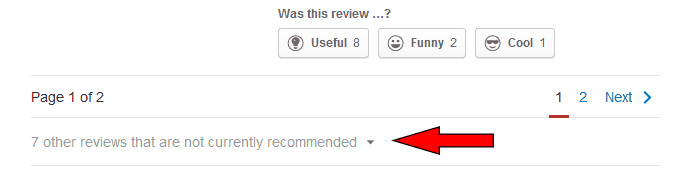
"Non recommended reviews" are reviews that take been filtered out past Yelp and non counted.
If a Yelp visitor chooses to dig deep and read them, they can. Just these reviews are hard to find, and they don't contribute to the business's Yelp rating or review count.
According to Yelp, their algorithm chooses to non recommend certain reviews because it's believed that the flagged review is fake, unhelpful, or biased. However, some reviews are filtered simply because the reviewer is inexperienced, not attuned to the tastes of most of Yelp's users, or other concerns that have nada to do with whether the Yelp users' recounting of their experience is accurate. Yelp says that roughly 25% of all user reviews are not recommended by the algorithm.
While Yelp at least admits that reviews may be filtered out merely because the reviewer isn't a frequent Yelp user, at that place'southward yet a lot that's unclear. That's a trouble, because the vagueness of this process could provide sufficient encompass to muffle bias or unethical behavior on Yelp'south part.
What actually determines whether a review is flagged by Yelp'southward filtering algorithm?
If you take some time to curlicue through a few Yelp pages, you lot'll come across reviews left by people who have written one review and don't fifty-fifty have a profile paradigm, while reviews from more established Yelp users end upwards in the dustbin.
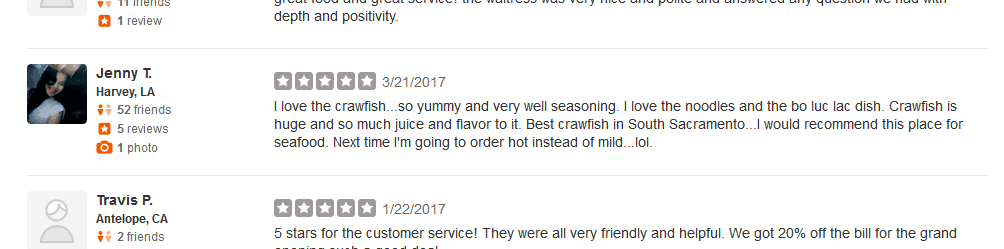
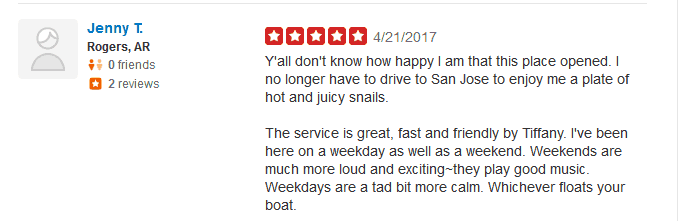
Why is the review above written by a user with 52 friends and v reviews filtered out, while the ane below makes the cut?
I've had to deal with Yelp issues when working with clients, and accept written about Yelp in the past (meet my article on "Dealing With Imitation Reviews on Yelp"). In contemplating the many frustrating bug with Yelp, I've long wondered if it would be possible to determine whether a given review would be more than or less likely to exist filtered out by Yelp's algorithm.
The core of that question is, what does Yelp consider to be the disquisitional components of a review'due south trustworthiness? I decided to try and find out.
What Yelp doesn't desire you lot to know, and for good reason.
There is a key limiting factor in whatever analysis of visible versus filtered reviews—you cannot look at the user contour of someone whose review is not recommended. Information technology's not clickable. So any comparison of the two classes of reviews tin't incorporate in-depth profile information—time spent on Yelp, their "Things I Love" list, whether a person has chosen a custom URL for their Yelp profile, etc.
In that location's a reason for that: Yelp doesn't want people to know how their algorithm works. If we knew exactly how it worked, so nosotros could game it. This significantly hampers the power of an outsider to penetrate the machinations of Yelp's algorithm.
Even so, there are a few things of which nosotros're pretty certain, simply which we can't analyze in a meaningful way:
Start, do not enquire customers to write a Yelp review while they're at your business.
Yelp'due south site and mobile phone application tin can hands determine your physical location when you submit a review. If you lot submit a review while you're at the business's location, Yelp will be able to tell, and it'southward extremely likely that they'll filter the review. A good way to go around this is to transport a follow-up electronic mail to the customer a few days later you aid them, request them how their experience was, and to leave a review for you if their experience was positive.
Don't provide customers with a direct link to your Yelp page if y'all're asking them to review your business.
Yelp tin can look at the referring domain name, and if they see that the person reviewing Doug'due south Fish Tank Store was referred by dougsfishtanks.com, they'll know that the customer was specifically referred past you and filter the review. Instead, simply say, "Please visit Yelp.com, look upward our business, and get out us a review." This eliminates the suspicious linking that would otherwise lead to the review being filtered.
The timing of reviews matters.
If you hold a solar day-long promotion during which you lot offer customers some sort of deal if they get out a positive review for your business on Yelp, what Yelp is going to see is that a business which had previously received but a handful of reviews over several years is suddenly getting multiple reviews on the same day. That's going to look only a teensy bit suspicious, and all of those reviews are going to end upward on the Island of Misfit Reviews, along with all of the other filtered reviews. If you lot insist on having some sort of promotion, spread it out over time. Make it office of your standard follow-up communication, as suggested higher up, rather than some sort of special upshot that immediately puts Yelp on high alert.
Nosotros can't attest to the in a higher place based on statistics and assay, because Yelp keeps that data in the digital equivalent of Fort Knox. But based on experienced, we can infer that the above is true.
Equally a result, my analysis is restricted to only the information that's publicly available to anyone who decides to spend a few hours itch through Yelp with an Excel spreadsheet. Essentially, my analysis assumes that all of the reviews that I looked at were left by honest, earnest individuals who weren't coerced past business owners or acting on calendar.
So, with that assumption in heed, what determines whether a Yelp review is filtered?
Designing a information analysis of Yelp reviews.
Ultimately, I chose to focus on five review variables: Whether the review's writer has a contour prototype, the number of friends they accept, the number of reviews they've written, how many photos they've submitted, and the rating of the review. I opted to choose five random businesses in the local Sacramento surface area: a restaurant, auto repair shop, plumber, clothing shop, and golf course. I would collect this data for each and every visible and filtered review for these five businesses, and see if the comparisons made anything articulate.
Now, at that place is a complicating factor for whatsoever comparison of Yelp reviews. In a phrase: power users. While many Yelp users are very easygoing, only leaving a minor handful of reviews, instead primarily using the service to view reviews left by other users. Just there is a minor a coalition of super users who contribute a LOT of reviews to Yelp.
This isn't an issue when it comes to looking at an average rating score. Whether you're a super user or a novice, your ratings get equal weight (unless your review gets filtered out), and a single rating can't swing things much, because in that location's a maximum of 5 stars.
Only when it comes to variables that don't take a maximum value, things can get a little crazy. For case, one business I looked at had 33 reviews. When I took a look at how many photos each user had previous submitted to Yelp, I found that while most users had contributed nix or very few photos, ane user had submitted 9,452 photos to Yelp. Look at this graph of each user's photo count, it's cool (keep in mind that the scale of the graph maxes out at 1,000 photos):
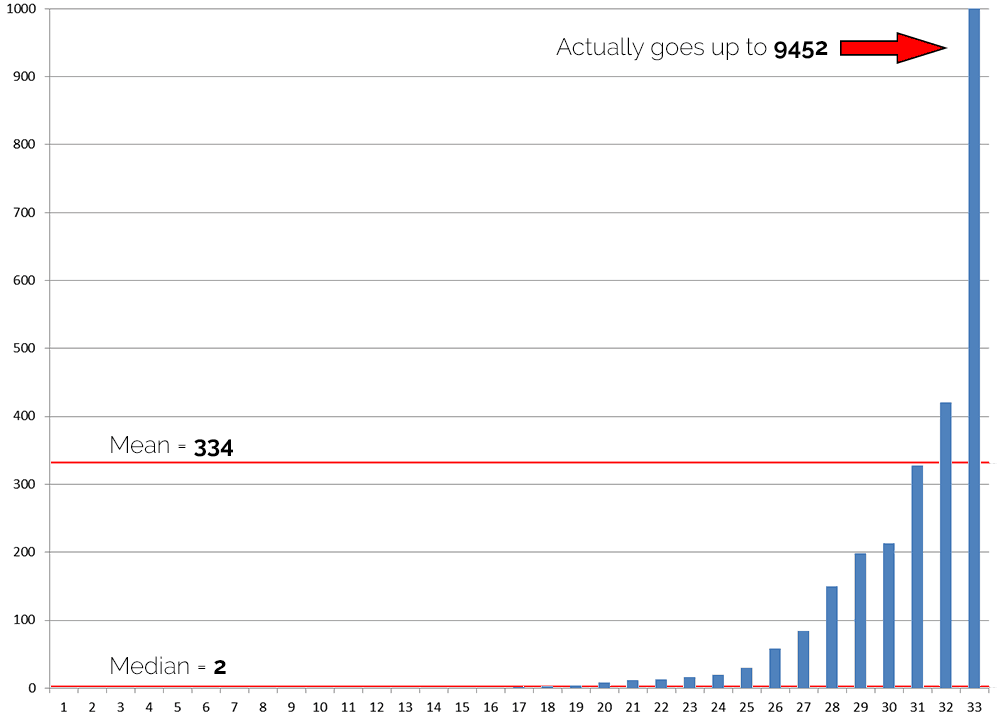
This presents a serious problem. A single person skews the boilerplate to an absurd degree—just two users' photograph counts exceed the mean. Information technology's like having the valedictorian in your math form. They completely wreck the grading bend.
With this in mind, for all other variables as well Yelp rating, I chose to use the median average. For our purposes, a median is really useful considering it gives united states a number where half the users in a group roughshod below that number, and half of the users are above it. The median is the proverbial C educatee, smack in the eye of the demographic.
With this in listen, the analysis beneath relies on the mean averages of user ratings, and the median averages of photograph counts, review counts, and friend counts. I also compared the percent of visible reviews that were left by users who ready profile images, versus the number left by users who didn't do so.
In each comparing, the starting time figure will be from the visible reviews, while the second will be from filtered reviews.
Average Yelp Rating
This wasn't nearly as exciting equally I expected (and hoped) it would be.
- Eatery: 4.1 vs 4.ane
- Auto Shop: four.iv vs 4.one
- Plumber: 4.iv vs 4.one
- Clothing: 4.3 vs iv.9
- Golf Course: 3.2 vs iii.6
In 2 cases, the boilerplate score for visible reviews was greater than that of filtered reviews. In one case, they were equal, and in two cases, the filtered reviews' average rating was greater than the visible review ratings.
This is the sort of fairly random distribution that you would expect if Yelp'southward algorithm didn't take the rating into account. Basically, Yelp isn't stealing your v star reviews.
Pct of Users with Profile Images
These days, social media has a huge impact on business organization and civilization. Consequently, information technology has become imperative to understand who a user is in order to have a better understanding of their viewpoint.
With this in mind, it'southward easy to meet how Yelp might be more mistrusting of an anonymous user who doesn't add a contour photograph, versus someone who does. And it appears the data supports this supposition.
- Restaurant: 71% vs 50%
- Machine Shop: 67% vs 62%
- Plumber: 49% vs 22%
- Clothing: 88% vs 33%
- Golf Course: 88% vs 60%
There is a very articulate trend here. With the auto shop the departure is pretty small, only in every case visible reviews were more likely to have profile images associated with them. Aside from the car store, there was 21 point or greater gap between in the apply of profile photos in visible reviews and subconscious reviews.
Within my data sample, the overall pct of visible versus filtered reviews with profile images was 71% versus 45%. The pretty clear takeaway from this is that the presence of a profile prototype does take an bear upon on review filtering.
Number of Yelp Reviews Posted
The number of reviews posted by a Yelp user does announced to significantly bear on the visibility of their reviews.
- Restaurant: 6 vs ane.5
- Auto Shop: 7 vs 1
- Plumber: seven vs 2
- Clothing: 10 vs ii
- Golf Form: 36 vs ii.5
The difference here is pretty stark. The plumbing business had the smallest gap, and even then the median visible reviewer had posted 3.5 times the number of reviews every bit the median filtered reviewer.
Looking at the raw data seems to reinforce the conclusion that review count is strongly factored into Yelp's algorithm: the five highest review counts for the 66 filtered reviews I looked at were 59, 20, 19, ix, and 9—just four.five% of reviewers with more than than five reviews were filtered. In one case a user's review count is in the high single digits—unless they've done something to make Yelp actually cranky—their reviews are almost guaranteed to show up.
In our personal experience, we have seen reviews which had been filtered for months or years of a sudden released from purgatory without explanation. Based on the data above, it seems probable that the reviews were unfiltered when users finally posted enough reviews to make Yelp happy.
The takeaway here is to non just encourage your customers to go out reviews for you, simply to do so for other businesses likewise; to exist more agile in reviewing their local community'due south businesses. Once they get by a total of nigh 6 or 7 reviews, it's very probable that all of their reviews will survive the algorithm's wrath.
Number of Yelp Friends
Information technology appears that the number of Yelp friends that a user has besides impacts the visibility of their reviews, but the correlation is a bit noisy when you dig deeper.
- Eating house: 15.five vs 2
- Car Store: one vs 0
- Plumber: 0 vs 0
- Vesture: 7 vs 0
- Golf Grade: 7 vs 0
In looking at the averages, there's definitely a gap. Nonetheless, in looking at the raw information, 10 of the 66 filtered reviews were written by users with 20 or more Yelp friends, with seven of them having more than than 35 friends. A pretty meaning chunk of the filtered reviews were written by social butterflies
It appears that while the friend count does have some impact, it'southward not well-nigh as determinative as the other factors described above. The takeaway is that having Yelp friends helps, but can exist outweighed by other factors
Number of Photos Posted
On the surface, the number of photos posted by Yelp users doesn't appear to have a profound impact on review visibility…
- Restaurant: iv.v vs 0.5
- Auto Shop: 7 vs 0
- Plumber: 0 vs 0
- Wearable: 0 vs 0
- Golf Grade: 2 vs 0
Plain, there are no instances in which users with filtered reviews averaged more than photos than those with visible reviews. Just for two businesses, the medians were both were 0, and the golf course comparing isn't terribly compelling either.
Notwithstanding, the raw data tells a very interesting story: at that place are very, very few filtered reviews posted by users with significant photo counts. Of the 66 filtered reviews, the top five photo counts were 26, 21, 6, v, and 2. That's a seriously desperate fall off. 94% of the filtered reviews were posted past users that had submitted 2 or fewer photos to Yelp.
The takeaway here is that while a lot of Yelp users don't mail service photos, posting fifty-fifty a pocket-size handful of photos has a pretty good likelihood of getting a user's reviews out of purgatory.
The Final Analysis of Our Lilliputian Yelp Experiment
To compact the couple thousand words or so to a higher place into something short and sweet, hither's what I think. Get-go of all, I don't run across evidence that the rating of a review has an bear on on whether a review is filtered or non.
Secondly, the other factors in play all definitely take some sway on whether a review is filtered. If I were to rank these iv variables in terms of importance, taking into account a user'south fourth dimension investment (it'd be great if every user wrote x reviews, but that takes a lot of time), this would be my ranking:
- Profile Prototype
- Photos Submissions
- Number of Reviews
- Number of Friends
Setting a contour image and uploading a couple photos of a business requires very trivial time, and the data indicates that these have a significant impact on the likelihood of a review existence visible. Later that, the quantity of reviews is very important, just the magical threshold where you lot're almost guaranteed to not be filtered is fairly high—around 6 to nine reviews. The number of friends matters besides, simply doesn't outweigh the factors above (and for users who aren't inclined to socialize on Yelp, it's going to be tough to convince them to practise otherwise).
The purpose of this analysis was to provide some actionable advice for concern owners. So, if you're managing a business and you lot want all of your reviews to show up, the information suggests that you don't need to target Yelp super users. You merely need to encourage your loyal customers to not just write a positive review, merely as well to take a couple minutes to add together a profile epitome and have and submit a couple photos of your business. Then, mayhap nudge them to leave reviews for other businesses as well to become their review count upwards. These little extra actions tin can significantly heighten the odds that their review of your business will show up.
washingtontheridly.blogspot.com
Source: https://www.postmm.com/social-media-marketing/yelp-reviews-not-recommended-data-analysis/#:~:text=%E2%80%9CNot%20recommended%20reviews%E2%80%9D%20are%20reviews,Yelp%20rating%20or%20review%20count.
0 Response to "Why Is My Review Not Recommended on Yelp"
Post a Comment